MCP server for the oee library: OEE, OOE, TEEP, the six big losses, reliability, yield and charts as tools for AI agents.
oee-mcp


An MCP server that exposes oee, the Overall Equipment Effectiveness library for Python, as tools for AI agents: give it machine times and piece counts and it returns OEE, the time waterfall, the six big losses, TEEP, and ready-to-show charts.
Agents asked to compute or report OEE tend to do the arithmetic themselves: a performance figure inverted, schedule loss left out, or - the usual mistake - OEE figures averaged across machines, which is wrong. Generated OEE fails silently. The calculation belongs in a deterministic, versioned, validated library that the agent calls, which leaves the agent to choose the analysis and explain the result.
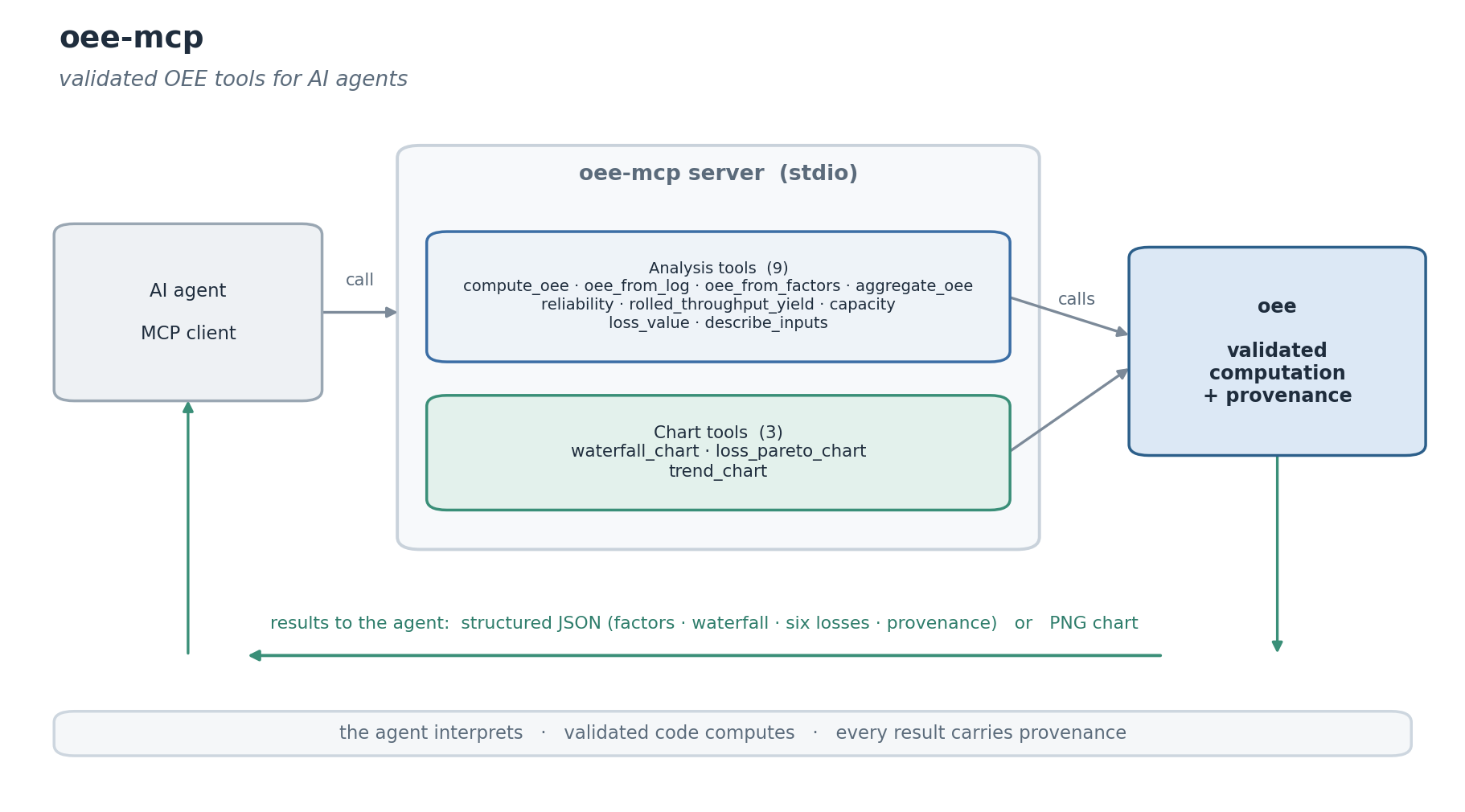
Tools
Analysis tools return the library's payload: the factors, the time waterfall, the six big losses, TEEP, alerts and provenance.
| Tool | Purpose |
| ---- | ------- |
| compute_oee | OEE, OOE and TEEP, the waterfall and the six big losses from times and counts |
| oee_from_log | OEE from an event log of production runs and downtime events |
| oee_from_factors | OEE from availability, performance and quality directly |
| aggregate_oee | roll OEE up across machines or shifts correctly (sums the buckets, never averages) |
| reliability | MTBF, MTTR and inherent availability |
| rolled_throughput_yield | the multi-step quality view (the product of the step yields) |
| capacity | takt time, the required rate, and whether a cycle time keeps up |
| loss_value | the availability, performance and quality losses as lost units and money |
| describe_inputs | the input fields, units and the metric definitions |
Chart tools return a PNG image.
| Tool | Purpose |
| ---- | ------- |
| waterfall_chart | the OEE time waterfall |
| loss_pareto_chart | a Pareto of the six big losses |
| trend_chart | OEE and the factors over a sequence of shifts |
All tools are read-only.
Installation
Run it with uv (no install needed):
uvx oee-mcp
or install from PyPI:
pip install oee-mcp
Configuration
Add it to your MCP client. For example:
{
  "mcpServers": {
    "oee": {
      "command": "uvx",
      "args": ["oee-mcp"]
    }
  }
}
If you installed with pip, use "command": "oee-mcp" with no args.
Example
compute_oee(machine={
  "planned_production_time": 420, "downtime": 47, "ideal_rate": 60,
  "total_count": 19271, "reject_count": 423, "all_time": 480
})
  -> { "factors": { "availability": 0.888, "performance": 0.861,
                    "quality": 0.978, "oee": 0.748, "teep": 0.654 },
       "summary": "oee - ...\n  OEE 74.8% ..." }
Design
The server is a thin, stateless wrapper. All of the arithmetic lives in the oee library, which computes OEE from the standard definitions and is validated against published worked examples (Vorne, TeepTrak) and the Nakajima world-class benchmark. The server adds the tool schema, read-only annotations and an input-schema helper so an agent can format the input and act on the result.
Related
- oee: the library this server wraps.
License
MIT. Written and maintained by Atakan Arikan, MSc Student at Tsinghua University and Politecnico di Milano.